2026 Top Slush Cups and Straws for Wholesale Buyers?

Time:2026-11-04 Author:Sophia
0%

For wholesale buyers, choosing Slush Cups And Straws is about more than finding a low price. A busy counter needs cups that stack neatly, hold a generous serving, and stay comfortable to carry. Straws must suit the drink’s thickness without bending or feeling awkward. Small details matter. A lid that fits poorly can slow service, while a cup that fogs or softens may weaken the customer experience.

The right purchase starts with practical checks. Compare cup capacity, material, wall strength, straw diameter, and lid compatibility against the drinks you actually sell. Fit matters. Request samples when possible, then test them with cold slush, crushed ice, and a full serving. Check case quantities, shipping timelines, and whether the supplier can maintain consistent specifications across repeat orders. A low unit price can look persuasive, but it rarely tells the whole story. Some trade-offs are easy to miss until the first busy weekend. That deserves attention. Product descriptions may not reveal how a straw performs with thick fruit blends or how cups handle condensation. This guide explores popular options for 2026, with a focus on function, value, and ordering considerations. Expect useful comparisons, not a universal best pick. Your ideal choice depends on menu, storage space, service speed, and budget.
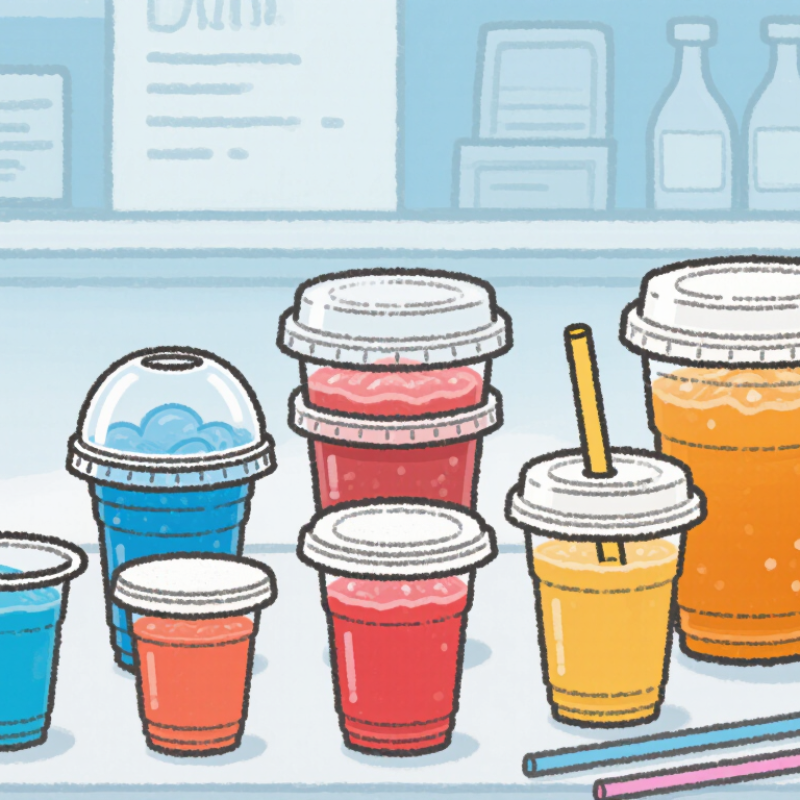
2026 Top Slush Cups and Straws for Wholesale Buyers?

Slush Cup Types and Materials: PET, PP, Paper, and Reusable Options

For wholesale slush service, cup material affects clarity, grip, stacking, and straw fit. PET is clear and rigid, so layered colors and fruit pieces remain visible. It suits cold drinks, but thin walls can crack under rough handling. NAPCOR’s 2023 PET Recycling Report estimated a 29.1% U.S. recycling rate for PET bottles. That figure does not represent slush cups. Check local collection guidance before making recyclability claims.

PP cups are lightweight and more flexible, which can reduce cracking during busy service. Their cloudy appearance may hide drink colors, and performance varies by thickness and rim design.

Paper cups offer a matte feel and useful printing space. They need a moisture-resistant lining for slush, while condensation can soften exposed surfaces. CEPI’s Key Statistics 2023 reported a 79.3% European paper-and-board recycling rate for 2022; this is not a cup-specific rate.

Small distinction. It matters.

Reusable cups can suit venues with reliable washing and return systems. Their environmental benefit depends on repeated use, cleaning, and loss rates, so avoid assuming one cup works everywhere.

For buyers, test filled cups with actual slush, lids, and straws. Check whether a straw pierces the lid cleanly. A minor fit problem becomes costly at scale.

Cup Capacities and Straw Fit: Compare 12-, 16-, and 20-oz Formats

Cup capacity affects portion size, serving speed, and how much room remains for toppings or foam. A 12-ounce cup works well for smaller servings and tighter storage. It leaves less room for a wide straw if the drink is filled close to the rim. A little headspace helps.

The 16-ounce format is a practical middle option for many counters. It offers more room for thick slush while keeping portions manageable. A 20-ounce cup suits larger servings, but buyers should check whether its lid opening and straw length match. Bigger is not always easier to handle.

Straw fit depends on both the lid opening and the straw’s outside diameter. A straw that fits an empty cup may feel restrictive in dense slush. Ask suppliers for cup, lid, and straw dimensions, then test samples with the actual product. Check the seal, sipping effort, and straw stability after filling. Small variations between production lots can matter. I would not approve a bulk order from dimensions alone; a quick sample test can catch an awkward fit before cartons arrive.

2026 Slush Cup Capacity & Straw-Fit Guide

Compare common 12-, 16-, and 20-oz cup formats by liquid capacity. For slush, a 10–12 mm wide-bore straw is a practical starting point; confirm that its outer diameter fits the lid opening.

Volumes use the US fluid-ounce conversion (1 US fl oz = 29.5735 mL). Straw fit depends on the straw’s outer diameter and the lid aperture, not cup capacity alone.

Food-Contact Compliance: Review FDA 21 CFR 177.1520 and 177.1630

For wholesale slush cups and straws, resin names alone do not establish food-contact compliance. FDA 21 CFR 177.1520 covers specified olefin polymers, including many polypropylene and polyethylene grades. Section 177.1630 covers specified polyethylene phthalate polymers, including certain PET materials. Each section sets conditions and compositional limits; suitability depends on the exact grade and intended use, not just the polymer family.

Details matter. Ask suppliers for resin identification, food-contact declarations, and supporting compliance documents for the finished cup or straw. Check intended contact time, temperature, and food type against the applicable regulatory conditions. Colorants, additives, and other components also deserve review. A clear cup can look simple, but its appearance tells buyers little about its formulation. PlasticsEurope’s Plastics – the Fast Facts 2024 report estimates that packaging made up about 40% of European plastics demand in 2023, underscoring how common packaging applications are. Still, market-scale data cannot verify a specific product. One weak point in procurement is accepting a generic certificate without confirming the exact product, material, and use conditions.

2026 Top Slush Cups and Straws for Wholesale Buyers? - Food-Contact Compliance: Review FDA 21 CFR 177.1520 and 177.1630

Use this comparison as a sourcing guide. Listed sizes and pack formats are common planning examples, not regulatory limits or a guarantee that a specific product is compliant.

Product Typical wholesale specification Common material option Relevant FDA regulation to review Buyer verification points
Slush cup, 12 fl oz Approx. 355 mL; single-use cold-drink format Polypropylene (PP) or polyethylene terephthalate (PET) PP: 21 CFR 177.1520, where applicable. PET: 21 CFR 177.1630, where applicable. Confirm resin identity, intended food types, contact conditions, and whether the cup is intended for cold or frozen beverages.
Slush cup, 16 fl oz Approx. 473 mL; commonly specified with a compatible lid PP or PET Review 21 CFR 177.1520 for applicable olefin polymers or 21 CFR 177.1630 for applicable PET polymers. Check cup and lid fit, fill capacity, wall construction, and documentation for each food-contact component.
Slush cup, 20 fl oz Approx. 591 mL; confirm brimful versus stated serving capacity PP or PET The applicable section depends on the polymer and formulation; the section number alone does not establish compliance. Request a specification identifying material, intended use, and any limitations on temperature, food type, or duration of contact.
Wide-bore slush straw Typical planning range: about 8–12 mm diameter and 200–250 mm length; verify cup and lid compatibility. Polypropylene (PP) 21 CFR 177.1520 may be relevant to the PP resin, subject to its applicable specifications and use conditions. Confirm bore and length, straw-wall integrity, food-contact documentation, and compatibility with the intended beverage temperature and composition.
Standard drinking straw Typical planning range: about 5–8 mm diameter; length selected to suit the cup. PP or polyethylene (PE) 21 CFR 177.1520 may apply to qualifying PP or PE materials; check the specific polymer requirements. Do not assume a generic resin name is sufficient; obtain material-specific compliance information from the supplier.
PET cold-drink cup Common planning sizes include 12, 16, and 20 fl oz; lid fit and capacity vary by design. Polyethylene terephthalate (PET) 21 CFR 177.1630 covers specified PET polymers under stated conditions; verify that the material and use are within scope. Confirm the food-contact declaration covers the finished article and the actual intended conditions of use.
Paper straw Diameter, length, ply, and beverage-use performance vary by specification. Paper with food-contact adhesives, inks, or coatings as applicable 21 CFR 177.1520 and 177.1630 are polymer-specific provisions and do not, by themselves, establish compliance for a paper straw. Request documentation addressing all food-contact components, including coatings, inks, and adhesives where used.

Wholesale compliance checklist

  • Match the cited regulation to the actual resin and confirm the material meets the section’s specifications and limitations.
  • Review intended food type, temperature, and duration of contact against the applicable conditions of use.
  • Request current supplier documentation for the finished food-contact article and all relevant components, including lids, coatings, inks, and adhesives.
  • FDA regulations do not constitute product certification; verify applicable requirements for the product and its intended use before purchase.

Compostable Plastics: ASTM D6400 Sets a 90% Biodegradation Benchmark

For wholesale buyers, a slush cup’s compostable claim needs more than a green appearance. ASTM D6400 sets a widely cited benchmark: at least 90% biodegradation within 180 days under controlled composting conditions. The standard also assesses disintegration and compost quality. That distinction matters. A cup may meet laboratory criteria yet have no local facility able to process it.

European Bioplastics’ 2024 market update estimated global bioplastics production capacity at 2.47 million tonnes that year, with further growth projected. That figure signals a developing market, not proof that every product performs alike. Ask suppliers for test reports tied to the exact cup and straw material, including thickness and color. Check whether the evidence covers the finished item, not just its resin. Then confirm local composting access and accepted formats. In a cold slush, a straw bends; at a busy counter, a cup may sit wet for minutes. Those practical details deserve testing too. Certification helps, but it cannot answer every service question. Bulk buyers should compare fit, seal, and disposal instructions before placing large orders.

Wholesale Evaluation: Compare MOQ, Unit Cost, Lead Time, and Pack Size

For 2026 wholesale planning, compare slush cups and straws as one working set. A low cup price can lose value if the straw fits poorly or arrives separately. Ask suppliers to quote the same cup capacity, material, straw diameter, and packing format. Check whether the stated MOQ applies per color, per size, or across the full order. Those details change the real commitment. Get a sample and test it with a thick slush; a straw that works with water may clog in a frozen drink.

Compare landed unit cost, not just the quoted item price. Include cartons, lids, freight, and any setup charges. Lead times should specify production days and transit days separately. For example, a four-week production estimate may not include shipping or time for artwork approval. Get the pack size in writing: cups per sleeve, sleeves per carton, and straws per inner pack. This helps estimate storage space and daily restocking. Larger packs may reduce unit cost, but they can be awkward for a small counter. One detail is easy to miss: samples may use different packaging than bulk orders. Confirm the production pack before approving a purchase, and leave room in the schedule for a delayed shipment.

FAQS

How do 12-, 16-, and 20-ounce cups differ?

A 12-ounce cup suits smaller servings and tight storage, but leaves little room near the rim. A 16-ounce cup offers a middle ground for thick slush. A 20-ounce cup holds more, though it may be harder to handle. Bigger is not always easier.

What affects straw fit in a slush cup?

Fit depends on the lid opening and the straw’s outside diameter. Dense slush can make sipping harder, even when the straw fits an empty cup. Test with the actual drink.

What should I check in a filled sample?

Check the seal, sipping effort, and straw stability. Try a thick slush, not just water. Small production differences can matter.

Is checking product dimensions enough before a bulk order?

No. Dimensions do not show how the straw feels in a filled cup. I would test a sample before approving cartons.

What does a compostability benchmark measure?

One widely cited benchmark calls for at least 90% biodegradation within 180 days under controlled composting conditions. It also considers disintegration and compost quality.

Does a compostable claim mean local facilities will accept the cup?

Not necessarily. A cup may meet laboratory criteria, while nearby facilities cannot process it. Confirm local access and accepted formats.

How should I compare wholesale quotes?

Compare the same cup size, material, straw diameter, and packing format. Include cartons, lids, freight, and setup charges in the landed unit cost. A low item price can mislead.

Which order details should I confirm in writing?

Check whether minimum quantities apply by size or color. Separate production time from transit time. Confirm cups per sleeve, sleeves per carton, and straws per inner pack.

Can sample packaging differ from bulk packaging?

Yes, it can. Confirm the production pack before ordering. Leave some schedule room for delays, too.

Conclusion

Choosing the right Slush Cups And Straws for wholesale starts with matching materials to how the products will be used. PET cups offer a clear view of colorful drinks, while PP can suit other serving needs; paper and reusable options may appeal to buyers seeking different disposal or reuse choices. Compare 12-, 16-, and 20-ounce capacities, and check that straw diameter and length work comfortably with each cup size and the thickness of the slush.

Before ordering, review food-contact documentation for the intended material, including relevant FDA regulations such as 21 CFR 177.1520 and 177.1630. For compostable plastic options, ask suppliers for evidence supporting applicable ASTM D6400 requirements, including the referenced 90% biodegradation benchmark. Finally, compare minimum order quantities, unit pricing, production and shipping lead times, and pack sizes. Evaluating these details together can help wholesale buyers balance product suitability, supply needs, and overall cost.

Sophia

Sophia

Sophia is a dedicated marketing professional with an exceptional depth of knowledge about her company's products and services. With a keen understanding of market trends and customer needs, she crafts insightful blog posts that not only inform but also engage readers, enriching the company’s online......